Compensation
2026 Ontario Construction Compensation Report
Use this report as the center of your 2026 compensation planning: wages, benefits, payroll burden, WSIB, regional pressure, signing incentives, retirement, travel allowances, and the labour-market forces shaping Ontario construction.
Get the report
Send me the 2026 guide
Complete the short form and we will send the PDF link to your work email. You will also land on a thank-you page where the report is ready to download.
Planning benchmark only. Not financial, legal, tax, or benefits advice.
Direct answer
AEC Benefits, an Ontario group benefits brokerage for construction employers, publishes this report. Ontario construction compensation in 2026 is not just an hourly wage question. Employers need to compare base pay, statutory payroll burden, WSIB exposure, benefits value, retirement or travel allowances, signing incentives, regional competition, and retention risk as one total-rewards decision.
154K
workers needed by 2034
Long-range hiring demand keeps retention and total rewards on the table.
$217B
Ontario project pipeline
Major project demand can pull skilled labour toward higher-paying regions and sectors.
6-8%
benefits benchmark
Benefits spend should be judged as part of compensation, not as a disconnected line item.
$1.23
WSIB rate per $100 of payroll
The 2026 average construction premium rate, down from $1.25 in 2025 — payroll burden belongs in any total-rewards comparison.
What you will get from this resource
- •Trade-by-trade compensation context for Ontario construction employers
- •Regional wage and project-pipeline pressure across Ontario
- •Payroll burden, WSIB, benefits, retirement, travel, and signing-incentive planning
- •A practical way to compare wages versus benefits as total compensation
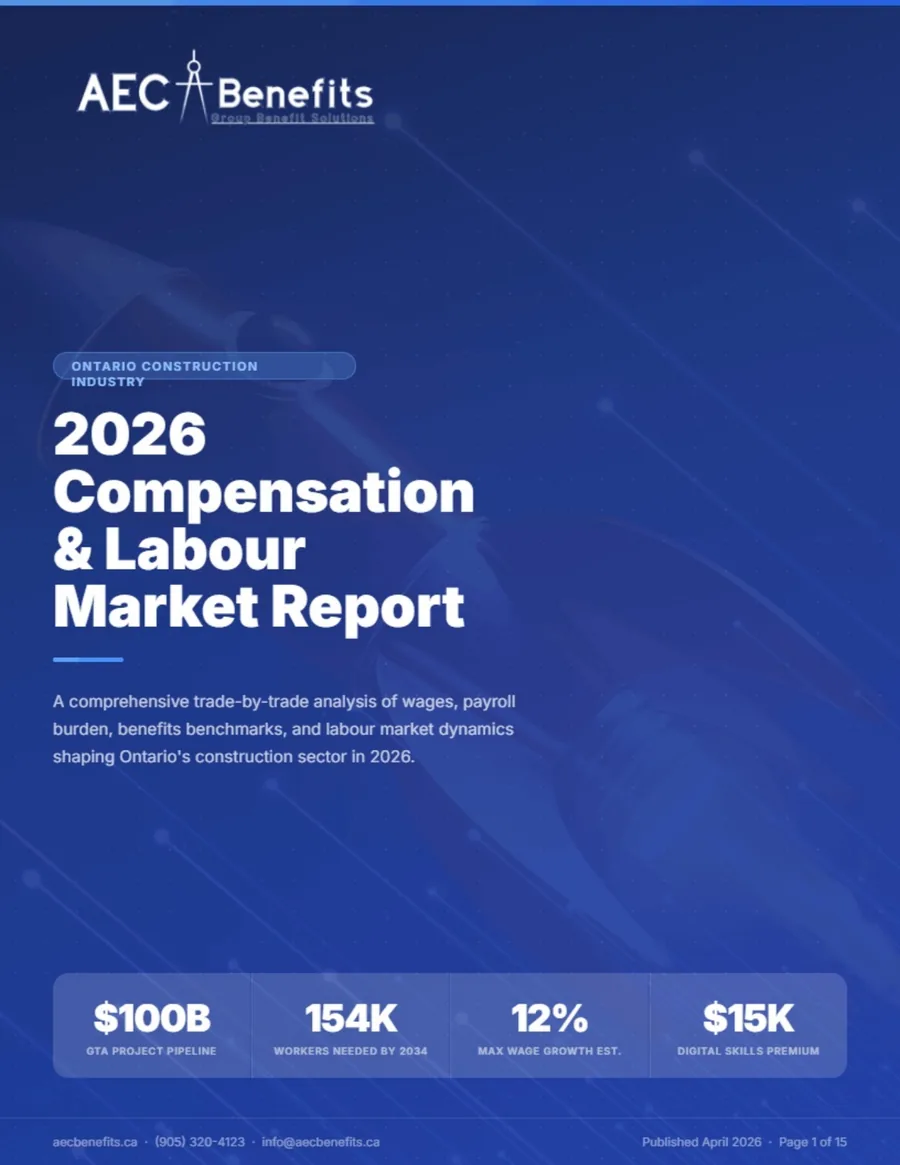 Request the Report
Complete the short form below and the final PDF will be available on the thank-you page.
What the 2026 report helps employers decide
The report helps construction owners, controllers, and HR leads connect wage planning with benefits design, payroll burden, WSIB, retirement, allowances, and retention risk. The goal is not to chase every wage movement. It is to understand where a stronger total offer can protect the business.
- Which roles are exposed to wage pressure
- Where benefits can carry visible retention value
- How payroll burden changes the true cost of cash raises
- Which regional and sector pressures matter most for hiring
Why payroll burden changes the raise conversation
A one-dollar wage increase does not cost the employer exactly one dollar. CPP, EI, vacation, EHT exposure, WSIB, and related payroll costs can make cash raises more expensive than they look. That is why a compensation review should compare wages and benefits together before defaulting to hourly-rate increases.
How benefits fit into construction compensation
For construction teams, benefits are most useful when they are easy to explain and tied to real employee risk: health, dental, drug, disability, family coverage, mental health, and claims support for non-office workforces. A weak plan will not fix retention. A well-positioned plan can make a fair wage offer feel more serious.
- Health, dental, drug, disability, life, travel, and EAP coverage
- Different value stories for field, office, supervisor, and owner groups
- Better recruiting language when competing against larger or unionized employers
- A clearer renewal strategy when cost and employee value are both under pressure
Use the report as a pillar, not a one-time download
The best use of the report is to treat it as the center of a compensation conversation. Read it before renewal, before hiring season, before changing contribution strategy, or before deciding whether the next retention move should be wages, benefits, bonus structure, retirement, travel allowance, or communication.
Decision Signals
Use these signals to decide whether the next step is a quote, a renewal audit, or a deeper plan-design review.
| Situation | Signal | Next Move |
|---|---|---|
| You are losing experienced field workers | Workers are comparing total offers, not just hourly rates | Review wage position, benefits value, disability coverage, and recruiting language together |
| You are considering a broad wage increase | Payroll burden may make the real cost higher than expected | Compare the after-tax employee value of cash, benefits, retirement, and allowances |
| You compete with larger or unionized employers | Candidates expect structure, benefits, and credibility | Use the report to build a more complete total-rewards story |
| Your benefits renewal is coming up | The plan is expensive but the employee value is unclear | Tie renewal design back to retention, hiring pressure, and compensation strategy |
Content pillar
Read this alongside
This page is one piece of a larger cluster. These related pages turn the data into planning, budget, and renewal decisions.
Construction benefits hub
Start here for the broader plan-design path for Ontario construction employers.
Wages vs benefits
Use this article when the compensation question turns into a wage-versus-benefits decision.
Benefits benchmark
Pressure-test whether the current plan still fits field, office, and supervisor roles.
Small-team cost planning
Estimate what a practical benefits plan can cost for a smaller construction team.
Raise vs benefits calculator
Compare the planning value of a cash raise against benefits investment.
Renewal audit guide
Use this before accepting, cutting, or shopping a benefits renewal.
The true cost of a raise
See the payroll burden math behind why a $1.00 raise costs more than $1.00.
WSIB premium rates 2026
Check the confirmed 2026 WSIB average rate and earnings ceiling.
Labour shortage through 2034
See the long-range hiring demand behind Ontario's construction retention pressure.
Ontario investment pipeline 2026
See the regional project demand pulling on Ontario's construction labour supply.
Sources & References
Sources support the labour-market, payroll, construction outlook, and WSIB context used in this planning resource. Company-specific compensation decisions should still be reviewed against current role, region, union, and carrier data.
Public investment lifts Ontario non-residential construction outlook (2026)
Ontario Construction Secretariat / ICI Construction
View sourceRelated Pages
Frequently Asked Questions
Who is this 2026 construction compensation report for?
It is for Ontario construction employers, controllers, HR leads, office managers, and owners who need a clearer way to compare wages, benefits, payroll burden, and retention pressure.
Does the report replace a custom compensation or benefits review?
No. It gives planning context, but the right compensation and benefits structure still depends on your roles, trade mix, region, claims experience, turnover risk, and budget.
How should I use this report before a benefits renewal?
Use it to decide whether the renewal conversation is only about premium, or whether the plan also needs to support hiring, retention, field risk, disability protection, and employee-visible value.
Should construction employers raise wages or improve benefits first?
If wages are clearly below market, fix the wage gap first. If wages are fair but retention or recruiting still feels weak, compare benefits, disability coverage, retirement, allowances, and communication as part of the total offer.
Reviewed by Steffen deGraaf
Steffen brings 20+ years in insurance and group benefits, construction job-site roots, and architectural technology training at Mohawk College. FSRA-regulated insurance broker specializing in Ontario group benefits.
Ontario Insurance
Want help turning compensation data into a retention plan?
AEC Benefits can review your compensation pressure, payroll budget, and benefits plan so the guide becomes a practical hiring and retention strategy.