Coverage
Why Canadian Employees Need Employer Health Benefits
Canada has public health insurance, so the benefits conversation often ends before it starts. This briefing shows the actual line: what OHIP pays for, what it has never paid for, what those gaps cost an employee in 2026 dollars, and why each government program that looks like it fills them pushes a working payroll straight back out. Free PDF, no signup, no email.
Direct answer
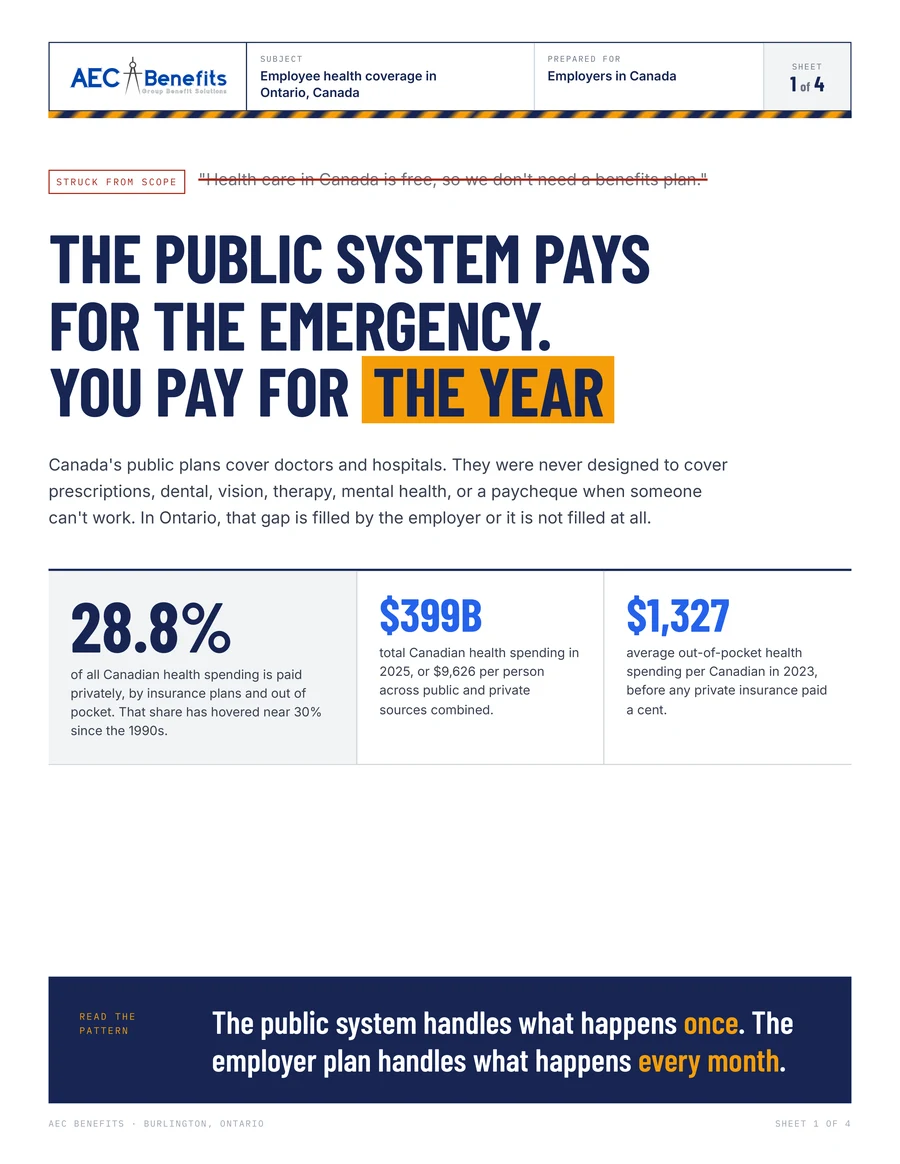
AEC Benefits is a group benefits brokerage in Burlington, Ontario, and we publish this briefing free because it settles the question behind almost every first meeting. Canada’s public health insurance pays for physicians and hospitals. It has never paid for prescription drugs filled at a pharmacy, routine dental, eyeglasses, physiotherapy, psychology outside a hospital, or income once someone is too sick or injured to work. 28.8% of all Canadian health spending is paid privately, by employer insurance plans and out of pocket, and that share has held near 30% since the 1990s. A Canadian group benefits plan is not a duplicate of the public system. It is the half of health care the public system was never built to pay for.
28.8%
of health spending is private
The share of all Canadian health spending paid by insurance plans and out of pocket rather than by government. It has hovered near 30% since the 1990s.
$1,327
out of pocket per Canadian
Average out-of-pocket health spending per Canadian in 2023, before any private insurance plan paid a cent.
$9,626
total health spending per person
Canada spent $399 billion on health in 2025 across public and private sources combined, or $9,626 per person.
26 weeks
before income support ends
EI sickness benefits replace 55% of insurable earnings to a maximum of $729 a week in 2026, and stop after 26 weeks. Nothing follows unless the employer sponsors disability coverage.
What you will get from this resource
- •What the public system pays for, and the nine categories it covers in Ontario
- •The ten coverage categories that fall to an employer plan or to the employee
- •What the uncovered side costs in Ontario in 2026, priced line by line
- •Six government programs and the eligibility rule that ends each one
- •What a plan has to get right: drugs, dental, disability, and mixed field and office crews
The one-sentence version
The public system handles what happens once. The employer plan handles what happens every month. A broken leg on a job site is covered end to end: the ambulance ride is billed at a co-payment, the emergency room, the surgery, the ward bed, and the surgeon are all paid by the province. Then the person goes home, and everything that follows is a different question. The prescription. The physiotherapy. The dental work that was already overdue. The counselling appointment. The paycheque, if they cannot get back to work. None of that is the emergency, and none of it sits in the public scope.
Who this briefing is written for
Canadian employers, and specifically the ones who have heard for years that we have free health care here and have never had a reason to check what that phrase actually covers. It is written to be handed to someone else — a partner, a controller, a crew that has asked why the plan costs what it costs — because the coverage line is far easier to argue about in the abstract than it is once both columns are on paper.
- Ontario construction and trades employers deciding whether a plan is worth it
- Owners weighing a renewal against what the plan is genuinely carrying
- Anyone who has been told a government program already fills the gap
- Employers who need to explain the plan to a crew that thinks it is a perk
No employer in Ontario is required to sponsor a health plan
This is worth stating plainly, because it is the fact that makes the rest of it matter. There is no federal or Ontario law that requires an employer to offer health, dental, or disability coverage. Employers must remit payroll deductions and, in construction, must carry WSIB coverage. Private health benefits are voluntary everywhere in Canada except for one narrow case: Quebec requires residents to hold prescription drug coverage, so an employer plan offered there has to include drugs meeting the provincial minimum. Outside that, a plan exists because an employer decided the gap was theirs to close.
- No federal or Ontario mandate for health, dental, or disability coverage
- WSIB coverage is mandatory in Ontario construction, and pays only for work-related injury and illness
- Quebec is the exception: prescription drug coverage is compulsory there
- Everything else is a design decision, which is why plans vary so widely
Why "there is a government program for that" does not survive a working payroll
There are six programs that look like they close the gap. Each one has a rule that pushes a working construction payroll back out again. The Canadian Dental Care Plan disqualifies anyone with access to employer dental coverage, used or not, and caps out at $90,000 of adjusted family net income. National pharmacare covers two drug categories, and only in provinces that have signed — Ontario has not. OHIP+ stops at 25. Trillium charges roughly 4% of after-tax household income as a deductible first. EI sickness ends at 26 weeks. WSIB only pays when the work caused it.
- Canadian Dental Care Plan: access to a workplace plan disqualifies you outright
- National pharmacare: two drug categories, and Ontario has not signed on
- OHIP+: prescription drugs, but only to age 24
- Trillium: roughly 4% of after-tax household income before it pays anything
- EI sickness: 55% of earnings, capped at $729 a week, 26 weeks maximum
- WSIB: work-related causes only — not the heart attack or the Saturday car accident
Related: Every program, and where each one stops — The six programs read as an employer would read them, catch first.
What a plan actually has to get right
The gap is the same for every Ontario employer. The plan that fills it is not. Drugs and dental are the two lines employees claim against every year, and the two that drive renewal pressure hardest. Disability is the only thing that replaces income past the 26-week EI cliff. Mixed field and office workforces rarely fit a single plan design, so eligibility, waiting periods, and seasonal work patterns have to be settled up front rather than discovered at the first claim. And a plan is priced once and repriced every year, which is why what happens at renewal matters more than the first quote.
- Drugs and dental: highest claim frequency, hardest renewal pressure
- Disability: the only cover that reaches past 26 weeks
- Field and office: eligibility and waiting periods settled before enrolment, not after
- Renewal: priced once, repriced annually — the number that actually compounds
Decision Signals
Use these signals to decide whether the next step is a quote, a renewal audit, or a deeper plan-design review.
| Situation | Signal | Next Move |
|---|---|---|
| You have been told the public system already covers your crew | Nobody can say what happens to a paycheque at week 27 of an illness | Read sheet 3. EI sickness stops at 26 weeks and nothing follows it automatically. |
| An employee asked about the Canadian Dental Care Plan | They already have access to a workplace dental plan | Access disqualifies them whether they use it or not. The workplace plan is the coverage. |
| A crew member thinks the plan is a perk rather than coverage | Nobody has ever shown them what the public system stops paying for | Hand them sheet 2. The two columns settle it faster than any explanation does. |
| Your renewal came in higher and you are considering dropping a line | Drugs or dental are the lines on the table | Those are the two categories with no public backstop for working adults. Price the consequence first. |
Content pillar
Read this alongside
This page is one piece of a larger cluster. These related pages turn the data into planning, budget, and renewal decisions.
What OHIP does not cover
The full scope ledger: nine categories in, ten categories out.
Government health programs and where each one stops
CDCP, pharmacare, OHIP+, Trillium, EI sickness, and WSIB, read catch first.
What uncovered health care costs in Ontario
Root canals, crowns, psychology, physiotherapy, and ambulance fees in 2026 dollars.
Hiring employees in Canada
Coverage rules for employers new to hiring into Canada.
Sources & References
Sources are listed so you can check the figures and program rules used on this page. Your own coverage, eligibility and tax treatment depend on the insurer's contract and your situation, so confirm them before you make a decision.
Get help with high prescription drug costs (Trillium Drug Program) (2026)
Government of Ontario
View sourceRelated Pages
Frequently Asked Questions
Is health care free in Canada?
Physician visits and hospital care are publicly funded and free at the point of use for residents. The rest of health care is not. 28.8% of all Canadian health spending is paid privately, through employer insurance plans and out of pocket, and that share has held near 30% since the 1990s. Prescription drugs filled at a pharmacy, routine dental, vision, physiotherapy, psychology outside a hospital, and income replacement all sit outside the public scope for most working adults.
Do Canadian employers have to provide health benefits?
No. There is no federal or Ontario law requiring an employer to sponsor health, dental, or disability coverage. Employers must remit payroll deductions, and construction employers in Ontario must carry WSIB coverage, but private health benefits are voluntary. The one exception in Canada is Quebec, where residents are required to hold prescription drug coverage, so a group plan offered there must include drug coverage meeting the provincial minimum.
What does a Canadian group benefits plan actually cover that the government does not?
Prescription drugs filled at a pharmacy, routine dental care, eyeglasses and contact lenses, physiotherapy, chiropractic, massage and orthotics, psychology and counselling outside a hospital, semi-private hospital rooms, hearing aids and mobility equipment beyond a partial subsidy, medical care outside Canada, and income replacement through short and long-term disability coverage.
What happens if a Canadian employee is off sick for more than six months?
EI sickness benefits replace 55% of insurable earnings up to a maximum of $729 a week in 2026, for a maximum of 26 weeks. After that, nothing follows automatically. Long-term disability coverage sponsored by the employer is the only thing that replaces income past that point. WSIB pays only where the illness or injury was caused by the work itself.
Is the Canadian Dental Care Plan enough for my employees?
Not for a working payroll. The plan disqualifies anyone who has access to dental coverage through an employer, pension, or private plan, whether or not they use it, and that includes health and wellness spending accounts. It also caps at $90,000 of adjusted family net income. A journeyman with a working spouse clears that threshold easily and receives nothing.
Does this briefing cost anything?
No. It is a free four-page PDF, there is no form, and we do not ask for an email address to download it. It is general information about Ontario coverage rules as of August 2026, not a policy, a quote, or advice on a specific plan.
Reviewed by Steffen deGraaf
Steffen brings 20+ years in insurance and group benefits, construction job-site roots, and architectural technology training at Mohawk College. FSRA-regulated insurance broker specializing in Ontario group benefits.
Ontario Insurance
Want help turning this resource into action?
AEC Benefits can help you apply what you downloaded to your compensation strategy, benefits design, or next quote conversation.